Chris (Kris) Okotie
Profile Overview
Chris Okotie, professionally credited on his early recordings as Kris Okotie, occupies a pivotal position in Nigerian music history. His emergence at the turn of the 1980s is frequently regarded as a symbolic turning point marking the transition from band-dominated Afro-funk formations to a commercially structured, solo-artiste-driven Nigerian pop era.
Beyond music, Okotie is a trained lawyer, writer, religious leader, and politician, making him one of the most multidimensional public figures to emerge from Nigeria’s popular culture landscape.
Education and Professional Formation
Okotie studied Law at the University of Nigeria, Nsukka, before proceeding to the Nigerian Law School, where he completed his professional legal training.
At a time when music was often regarded as a career for those without formal academic direction, his academic credentials challenged prevailing assumptions. His success helped legitimise popular music as a viable profession for educated Nigerians.
Early Recording: In The Beginning (IRIL)
Okotie’s first release, In The Beginning, appeared on the IRIL record label. The project introduced his smooth vocal delivery and romantic pop sensibility, positioning him within an emerging urban audience receptive to polished studio productions.
Though modest in scale, it laid the groundwork for a significant commercial breakthrough.
The Phonodisk Breakthrough (1980)
Okotie’s signing to Phonodisk Records, founded by Haruna Ishola, marked the defining phase of his music career.
In 1980, he released two albums under Phonodisk:
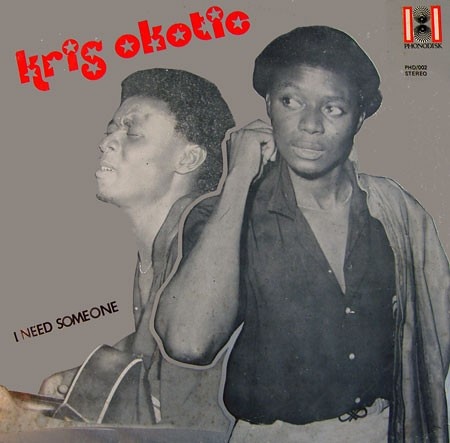
- I Need Someone (1980)
- Just For You (1980)
Phonodisk invested heavily in his development and promotion, sparing little expense in production, marketing, and packaging, particularly on I Need Someone. Under the production guidance of Odion Iruoje, one of Nigeria’s most respected pop producers of the era, Okotie’s sound was refined into a sleek, radio-friendly format.
Iruoje’s structured arrangements and studio discipline were central to shaping Okotie into a commercially viable pop star.
The “Golden Boy of Nigerian Music”
At the height of his popularity, Okotie was widely referred to as the “Golden Boy of Nigerian Music.” The title reflected both his rapid commercial ascent and his polished public persona.
His success is frequently described as the moment Nigerian music pivoted from the dominance of large Afro-funk and highlife bands toward:
- Solo artiste branding
- Tighter pop song structures
- Studio-driven production
- Youth-oriented urban appeal
In this sense, his entrance into the mainstream marked a structural shift from Afro-funk era dominance to the Nigerian pop era of the early 1980s.
Move to EMI (HMV Imprint)
Following his success at Phonodisk, Okotie moved to EMI, recording under its HMV imprint.
He released:
- Show Me Your Backside (1981)
- Please Don’t Go (1982)
Industry observers have often suggested that his departure weakened Phonodisk’s competitive position at a critical moment in Nigeria’s evolving recording industry. His migration reflected broader structural changes, including increasing influence from multinational labels in the Nigerian market.
After his exit, Phonodisk released a retrospective compilation:
- The Best of Chris Okotie (1982)
The compilation underscored the continuing commercial value of his catalogue even after he had left the label.
Influence on the 1980s Pop Generation
Okotie’s breakthrough influenced a generation of emerging solo performers in the 1980s. Among those associated with this wave were:
- Jide Obi
- Amas Grill
- Felix Lebarty
- Loraine Okotie
Felix Lebarty would later become one of the defining pop figures of the mid-1980s, reinforcing the commercial viability of the solo pop format that Okotie helped establish.
Collectively, this generation consolidated the transition away from band-dominated Afro-funk toward a more individualised pop structure that defined much of Nigeria’s urban music culture in the decade.
Transition to Ministry, Writing, and Politics
In 1984, Okotie publicly declared himself born-again and gradually withdrew from the music industry. He founded and became pastor of the Household of God Church in Lagos, redefining his public identity.
He later became active in national politics, contesting the Nigerian presidential election twice under his Fresh Democratic Party, though unsuccessfully. In addition to his roles in ministry and politics, he is also known as a writer and public commentator.
Historical Positioning
Chris (Kris) Okotie’s active recording career was relatively brief, but its timing placed him at a structural turning point in Nigerian music history.
He represents:
- The professionalisation of Nigerian pop
- The legitimisation of music as a career for educated Nigerians
- The shift from Afro-funk band dominance to solo pop stardom
- A generation that reshaped the commercial direction of the industry
His legacy lies not merely in album sales, but in the transformation of Nigeria’s musical orientation at the dawn of the 1980s.
Joseph Asikpo